Most businesses that hire content marketing SEO services aren’t short on content. They’re short on results. Content marketing SEO services combine keyword-driven content creation with technical and on-page optimization so that what you publish actually ranks, gets found by both search engines and AI answer tools, and moves readers toward a purchase decision, not just adds another post to the blog archive.
If you’ve been publishing for months and your traffic looks fine while your pipeline doesn’t, this guide walks through exactly why that happens and how to fix it.
Keypoints
- Content marketing SEO services combine keyword research, content creation, and on-page optimization to drive organic growth.
- A content marketing strategy defines audience intent and goals; a content calendar alone isn’t a strategy.
- Answering the core question in the first 80–100 words boosts AI Overview citation chances.
- Topic clusters (pillar + supporting posts) build topical authority faster than standalone blog posts.
- Recently updated content is cited far more often in AI-generated search summaries.
- FAQ sections with 50–80 word answers are structured for featured snippets and AI citation.
- Sage Mind Marketing builds strategy and SEO execution together, not as separate services.

Why “Just Post Consistently” Stopped Working
Publish twice a week. Use your keywords. Add some internal links. That advice worked when the internet had less competition and search engines were the only place people looked for answers.
Two things changed. First, every competitor in your space is now doing the same thing, which means “good enough” content no longer stands out; it just adds to the noise. Second, a growing share of searches never reach your website at all, because AI Overviews and chat-based answer engines summarize the response directly on the results page. If your content isn’t structured to be pulled into those summaries, you lose that visibility entirely, even if you would have ranked well two years ago.
This is the gap content marketing SEO services are actually built to close: not “more content,” but content engineered to perform in both environments at once.
What Are Content Marketing SEO Services, Exactly?
Content marketing services and SEO are usually sold as separate line items: a writer for the blog, a specialist for technical fixes. Treated separately, they undercut each other. A perfectly optimized page with thin, generic writing won’t hold attention long enough to rank. Well-written content with no keyword strategy or internal linking structure won’t get discovered in the first place.
Combined properly, the process looks like this:
- Research defines what your audience is actually searching for, in their own words, at each stage of their decision.
- Content creation answers that search intent directly, without padding.
- On-page SEO makes the page legible to search engines: structured headings, schema, internal links, fast load times.
- Distribution gets the piece in front of people who wouldn’t have found it through search alone.
- Measurement tells you which pieces to update, expand, or retire.
None of these steps work in isolation. That’s the actual definition of the service, not “SEO-friendly blog writing.”
What Is Content Marketing Strategy?
A content marketing strategy is the reasoning behind what you publish, in what order, and why, as opposed to a content calendar, which is just a publishing schedule. A calendar tells you Tuesday’s topic. A strategy tells you why that topic exists, who it’s for, and what it’s supposed to do once someone reads it.
A strategy answers four questions before a single piece gets written:
- Who exactly are we writing for, and what do they already believe or misunderstand?
- What are they searching for at each stage, first learning about the problem, comparing options, or ready to choose?
- What should this specific piece accomplish: a subscriber, a demo request, a sale?
- How does this piece connect to the rest of the site, so it isn’t an isolated, orphaned page?
Skip these questions, and you get a blog that reads fine but doesn’t move any business metric. That’s the single most common failure pattern in content programs that plateau after the first few months.
How to Write Content for SEO (Without It Reading Like SEO Content)
This is where most in-house teams and freelancers lose the plot; they write for the algorithm instead of the person, and it shows. Here’s what actually works:
Answer the core question immediately. Don’t build up to it in three paragraphs of scene-setting. Whether a human reader or an AI summarization tool is scanning your page, they need the direct answer within the first 80–100 words. Everything after that is supporting detail, not the reveal.
Match headings to how people actually phrase questions. “Content Marketing Strategy Components” ranks worse than “What Are the Components of a Content Marketing Strategy?” because it mirrors real search and voice queries, and it’s exactly the format AI answer engines pull from.
Use specifics, not summaries of specifics. “Improves visibility over time” says nothing. “Ranks climb as internal links from newer posts point back to the page” says something a reader can act on.
Cut the transition filler. Phrases like “in today’s digital landscape” or “it’s important to note that” add zero information. If a sentence would read the same with the phrase deleted, delete it.
Write toward a decision, not just an explanation. Every section should leave the reader either more informed or closer to acting, ideally both.
Building the Strategy: Step by Step

1. Map Audience Intent Before Touching a Keyword Tool
Start with what your buyer actually struggles with, not their job title. A persona sheet with “Marketing Manager, 30–45” tells you nothing about what content to write. Knowing that they’re frustrated by agencies overpromising and underdelivering tells you exactly what angle to take.
Sort topics into three intent stages: problem-aware (they don’t know a solution category exists yet), solution-aware (comparing approaches), and product-aware (ready to evaluate specific vendors). A strategy that only covers the top of that funnel generates traffic with nowhere to convert. One that only covers the bottom has no way to bring new people in.
2. Do Keyword Research That Reflects Real Demand
Tools like Google Search Console, Ahrefs, or Semrush show you what’s already driving impressions and where you’re ranking on page two instead of page one, often the fastest wins available, because the content already exists and just needs strengthening rather than replacing.
Prioritize by a mix of realistic ranking difficulty and buying proximity, not raw search volume. A term with modest volume but clear purchase intent will outperform a high-volume, generic term almost every time.
3. Build Topic Clusters, Not Standalone Posts
A single unconnected article on a competitive topic rarely ranks. A pillar page covering the broad topic, supported by several cluster posts that go deep on subtopics and link back to it, signals topical depth that search engines reward, and gives readers a logical next step instead of a dead end.
If you’re weighing whether to build this in-house or bring in outside help, a dedicated content creation services team typically has this cluster mapping already systemized, which shortens the ramp-up considerably compared to figuring it out post by post.
4. Write for Both the Search Result and the AI Summary
Two behaviors matter more now than they did even a year ago: freshness and citability. Content published or meaningfully updated recently is disproportionately more likely to be pulled into AI-generated answers, which reward pages that stay current over pages that were accurate once and never touched again.
To make a page citable by a reader or a summarization model, include concrete numbers with a named source, direct FAQ-style answers in the 50–80 word range, and named authorship where credibility matters (for crucial topics like health, finance, or legal matters, this is close to non-negotiable).
5. Optimize the Page Itself
Title tags should carry the primary keyword without reading like it was forced in. Meta descriptions won’t move your ranking directly, but a specific, benefit-led one materially changes your click-through rate, which is a ranking signal search engines do track. Headers should follow a logical hierarchy that a crawler and a skimming reader can both follow. Images need real alt text, not “image1.jpg.” None of this is technically hard; it’s just the part teams skip when they’re rushing to hit a publishing quota.
6. Distribute: Don’t Just Publish and Wait
A great page with no promotion plan sits invisible for months. Internal links from your existing high-traffic pages, a mention in your newsletter, and outreach to sites already covering your space all compress the time it takes a new piece to gain traction.
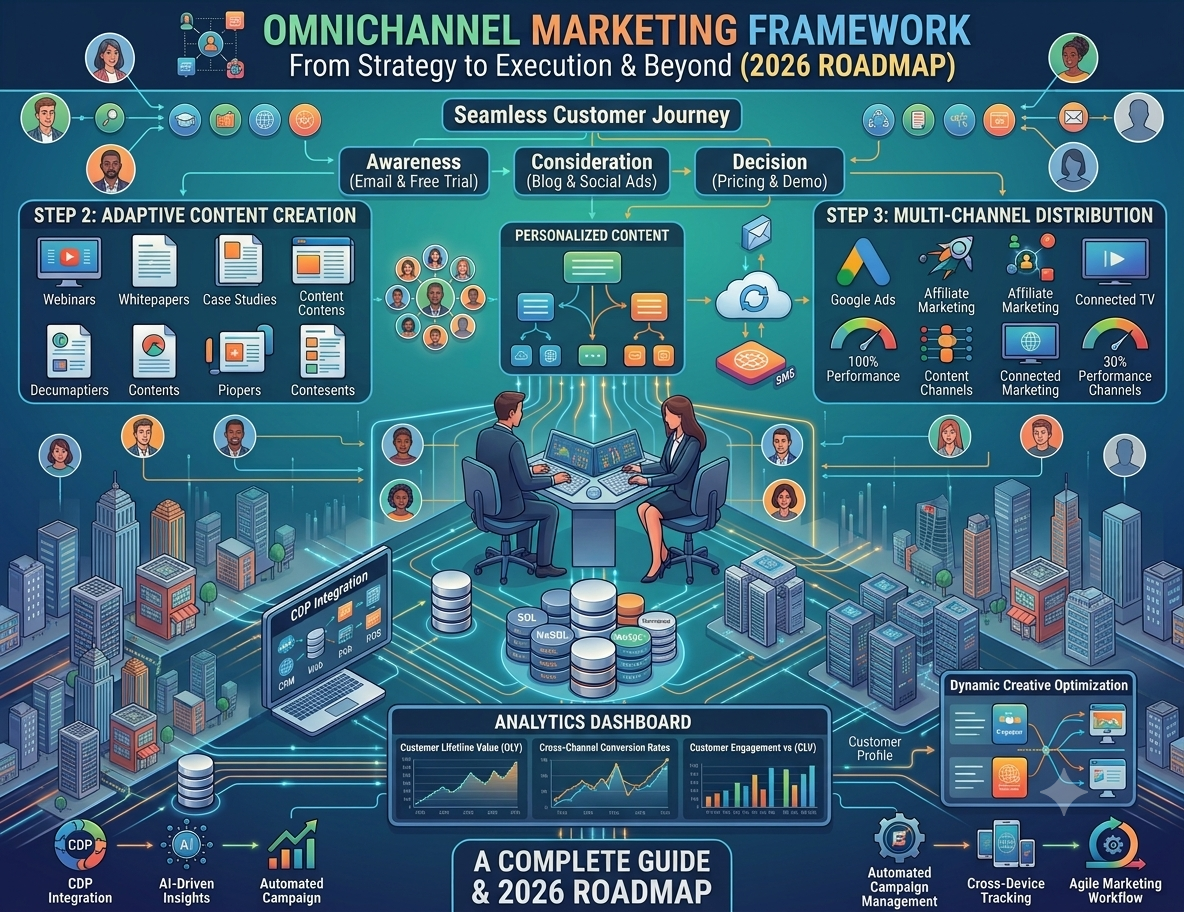
Distribution also isn’t limited to a single-channel strategy. If your brand shows up consistently across search, social, and email with a coordinated message, that’s effectively what an omnichannel marketing agency is built to coordinate, and it compounds the return on every piece of content you’ve already produced, rather than asking each new post to carry all the weight alone.
Content Creation Agency vs. In-House: What Actually Changes
Neither option is universally “better”; the right call depends on what you’re missing. In-house teams usually understand the product and audience nuance better than any outside partner ever will. What they’re often missing is the systemized process: standardized briefs, a repeatable audit cadence, and the bandwidth to keep a refresh schedule alive once the initial publishing push slows down.
A content creation agency earns its cost when it brings that missing infrastructure, not just extra writers, but a system for prioritizing what gets written, refreshed, or cut. If you’re evaluating one, ask specifically how they handle topic prioritization and update cadence. If the answer is “we write what you ask for,” you’re paying agency rates for freelance execution.
How to Do Content Marketing That Converts, Not Just Ranks
Ranking without conversion is a common trap, especially for local and service-based businesses competing in a specific geography. A business targeting, say, “digital marketing in Long Beach” searches needs location-specific proof, case studies, service-area pages, and local signals, not just generic national content dressed up with a city name inserted. We’ve seen this play out directly in local, geo-targeted campaign work, where specificity to a market outperformed broader, less targeted content by a wide margin.
The same logic applies at every funnel stage. Every page needs one clear next step, a subscribe form, a consultation request, a demo, designed around what that specific reader is ready for, not a generic “contact us” bolted onto the bottom of every post.
Mistakes That Quietly Kill Organic Growth
Publishing without a defined intent target. If you can’t state in one sentence what question this page answers and for whom, it won’t convert even if it ranks.
Treating internal linking as an afterthought. New pages with no links pointing to them from existing content take far longer to gain authority, and orphaned pages rarely rank at all.
Letting content go stale. A page that ranked well eighteen months ago and hasn’t been touched since is actively losing ground to competitors who are updating theirs.
Optimizing for volume over depth. Four thin posts a month lose to one well-researched piece almost every time, especially now that thin content is systematically filtered out of AI-generated answers.
Keyword stuffing. It reads badly to humans and gets algorithmically penalized; no version of this still works.
Measuring What Actually Matters

Traffic is a leading indicator, not the goal. Track organic sessions to gauge growth trajectory, but weight your reporting toward keyword rankings on strategic (not vanity) terms, click-through rate on your titles and descriptions, and most importantly, content-assisted conversions, since a huge share of content’s real value shows up in the buyer journey before the final conversion event, not at it. According to Google’s own guidance on helpful content, content built primarily to satisfy readers, rather than to game rankings, is the version that holds up over algorithm updates, which is as close to a long-term guarantee as this space offers.
Give new content a minimum of 90 days before judging performance. Search engines and AI systems both need time to crawl, index, and build enough confidence in a page to surface it consistently.
Conclusion
Content marketing SEO services work when the writing and the optimization are built together, not bolted on after the fact. Map real intent, build clusters instead of standalone posts, write pages structured to be cited by both search engines and AI tools, and give every piece a distribution plan and a clear job to do.
This is exactly the approach Sage Mind Marketing brings to every content engagement: strategy first, execution systemized around it. Do that consistently, and the traffic graph starts moving alongside the numbers that were actually the point all along.
Frequently Asked Questions
What is a content marketing strategy?
It’s the framework connecting audience intent, business goals, and content decisions: who you’re writing for, what they search, and what each piece should achieve.
How do content marketing SEO services differ from regular SEO?
Regular SEO covers technical and on-page factors. Content marketing SEO services add the research and writing layer, matching content to real search intent and AI-citation structure.
How long does it take to see results from a content strategy?
Most pages stabilize in rankings within 60–90 days. Sustainable growth usually shows by month three to six.
Should I hire a content creation agency or build in-house?
Depends on what’s missing. In-house teams know the product; an agency earns its cost by supplying process and systemized prioritization.
How much content should I publish per month?
Two to four well-researched pieces beat higher-frequency shallow publishing, especially with thin content now filtered out of AI answers.

Sage Mind Marketing is a Long Beach-based marketing agency helping businesses grow with expert branding and digital strategy to increase online visibility.